
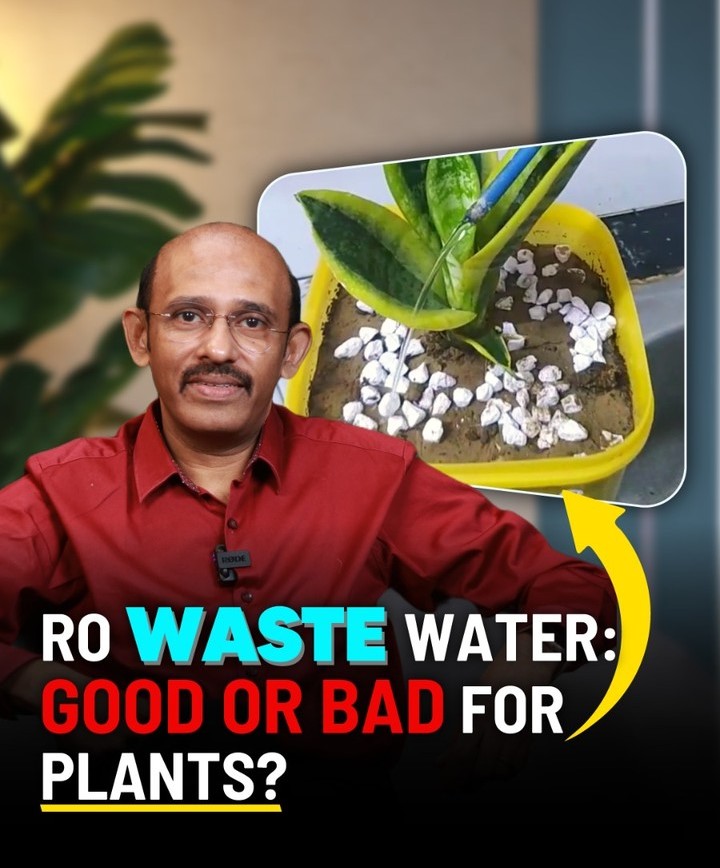
The Ultimate Guide to RO Reject Water: Can You Use Purifier Wastewater for Plants?
Walk into almost any modern household, and you will find a Reverse Osmosis (RO) water purifier running in the kitchen. These systems are incredible at removing harmful chemicals, heavy metals, and micro-contaminants from our drinking supply. But they come with a glaring environmental drawback: for every single litre of pure drinking water produced, an RO system typically discards up to two to three litres of wastewater.
Watching this reject water pour down the kitchen sink can feel like a massive waste of water. Naturally, many homeowners ask a common question: Can I save this water and use it to water my houseplants?
The answer is not a simple yes or no. Before you start dumping your purifier’s wastewater onto your favourite indoor greenery, there is a critical scientific factor you must understand—Total Dissolved Solids (TDS). Using this water without testing it first can accidentally damage or kill your plants.
The Paradox of RO Purifiers: Why They Waste So Much Water
How the Reverse Osmosis Process Separates Impurities
To understand why the reject water is so concentrated, we have to look at how a reverse osmosis membrane operates. Unlike standard physical filters that simply trap dirt in a mesh, an RO system uses a semi-permeable membrane and high water pressure to separate water at a molecular level.
The system divides the incoming tap water into two distinct streams:
The Permeate Stream: Pure water molecules that successfully pass through the membrane into your storage tank.
The Reject Stream: The remaining water that carries away all the filtered-out salts, heavy metals, and minerals.
The Concentration Effect
Because all the impurities from the original water source are concentrated in the smaller reject stream, the wastewater exiting the discharge tube has a much higher concentration of dissolved solids than the tap water that entered the machine. This is why it is called “reject water”—it is essentially highly concentrated mineral and salt water.
The Golden Rule: Why You Must Check the TDS First
The Critical Importance of the TDS Test
Before you route your RO discharge tube directly into your garden beds, you must perform one essential test: check the Total Dissolved Solids (TDS) of the reject water. You can easily find an affordable, handheld digital TDS meter online.
[Collect RO Reject Water] ➔ [Insert Digital TDS Meter] ➔ [Read PPM Value] ➔ [Decide Destination]
The 1,500 PPM Threshold
When you test the water, look closely at the parts per million (ppm) reading:
Below 1,500 PPM: This water is generally safe to use for most outdoor garden plants and sturdy shrubs.
Above 1,500 PPM: Do NOT use this water for your plants.
Just as humans cannot safely consume water with a TDS level above 1,500 to 2,000 ppm, our plants will struggle to handle it as well. Plants are living organisms that rely on clean water to maintain cell structure and transport nutrients. Flooding their roots with excessive dissolved salts will quickly disrupt this natural balance.
The Biological Connection: How Plants React to High Salt Levels
The Internal Blockage Crisis
When you pour water with a TDS level above 1,500 ppm onto your soil, you introduce a large amount of dissolved mineral salts into the plant’s root environment.
Over time, these salts build up in the soil and physically block the tiny pathways inside the roots. Instead of drawing up hydration, the plant’s root system becomes clogged, effectively starving the plant from the inside out.
High TDS Water ➔ Soil Salt Accumulation ➔ Root Pathway Blockage ➔ Scorched Leaf Tips
Identifying Symptoms of Salt Burn
If you accidentally water your plants with high TDS reject water, you will notice distinct warning signs:
Leaf Tip Scorch: The edges and tips of the leaves will turn a crisp, brittle brown.
Stunted Growth: The plant will stop producing new shoots or flowers.
Wilting: Even though the soil is wet, the plant will appear wilted because its clogged roots cannot absorb the moisture.
Exceptions to the Rule: Which Plants Can Survive High TDS Water?
While most delicate household plants and vegetables will quickly wither under high-salt conditions, certain plant varieties are naturally built to handle tougher environments.
Plants with Fibrous Root Systems
Certain plants feature deep, dense, fibrous root systems that are excellent at filtering out excess minerals before they reach the main stems.
Halophytic and Coastal Varieties
Coconut Trees: These coastal giants are highly salt-tolerant and can easily process water with elevated mineral levels.
Seashore and Oleander Shrubs: Plants naturally found near coastlines can tolerate higher TDS water without experiencing leaf burn.
Sturdy Ornamental Grasses: Many wild landscaping grasses have adapted to handle hard water and mineral-rich soils.
However, unless you are exclusively growing salt-tolerant coastal plants, keeping high TDS reject water away from your garden is the safest choice.
What Else Can You Do with High TDS Reject Water?
If your RO purifier’s reject water tests above 1,500 ppm, you shouldn’t use it on your plants—but that doesn’t mean it has to go down the drain. There are plenty of great ways to reuse this water around the house:
                  ┌➔ Below 1,500 PPM ➔ Safe for Garden & Lawn Irrigation
[RO Reject Water] ┤
                  └➔ Above 1,500 PPM ➔ Ideal for Mopping, Flushing, & Pre-Washing
1. Household Cleaning and Mopping
High TDS water is perfect for mopping tiled floors, washing down balconies, or scrubbing patios. The mineral content won’t impact its cleaning power when mixed with a good floor cleaner.
2. Flushing Toilets
You can collect the wastewater in a large bucket in the bathroom and use it to manually flush toilets, saving gallons of fresh municipal water every day.
3. Pre-Rinsing Heavily Soiled Laundry
While you shouldn’t use high-mineral water for a final laundry rinse (as it can leave clothes feeling stiff), it is excellent for a preliminary soak or pre-wash to lift mud and dirt from tough fabrics or car rags.