
The Ultimate Deep-Dive Guide to Groundwater Safety: Managing TDS, Heavy Metals, and Modern Filtration
Many social media channels romanticise the past, claiming that our ancestors lived incredibly healthy lives by drinking straight from natural wells. However, historical data tells a completely different story. Mortality rates were significantly higher in previous generations. Lacking advanced medical diagnostics, many people suffered and died from chronic illnesses like cancer and diabetes without ever knowing what caused them.
A major contributor to these historical health issues was untreated groundwater. Without modern testing facilities, communities regularly drank water packed with invisible heavy metals and high levels of Total Dissolved Solids (TDS), leading to widespread organ damage and chronic kidney stones. To protect your household, you need to understand the science of groundwater contamination, how to read water quality metrics, and how to choose the right filtration system.
The Hidden Chemistry of Groundwater(TDS)
When rainwater trickles down through topsoil and rock layers into underground aquifers, it acts as a universal solvent. Along the way, it picks up various minerals, salts, and heavy metals.
Breaking Down Total Dissolved Solids (TDS)
Total Dissolved Solids (TDS) measures the total amount of mobile charged ions dissolved in a given volume of water. It is expressed in parts per million (ppm) or milligrams per liter (mg/L).
The primary inorganic components typically found in a borewell profile include:
Cations: Calcium ($Ca^{2+}$), Magnesium ($Mg^{2+}$), Sodium ($Na^+$), and Potassium ($K^+$).
Anions: Carbonates ($CO_3^{2-}$), Bicarbonates ($HCO_3^-$), Chlorides ($Cl^-$), Sulfates ($SO_4^{2-}$), and Nitrates ($NO_3^-$).
While minor trace amounts of these elements give water its natural taste, excessive amounts create hard water that scales appliances and strains your kidneys.
The Geological Seepage of Toxic Metals
Heavy metals like lead, arsenic, and hexavalent chromium can leach into groundwater from natural underground deposits or nearby industrial runoff. Because these metals don’t change the color, smell, or taste of the water, you could be consuming dangerous toxins every day without noticing a difference.
Evaluating Health Risks Against Official Safe Limits
To understand how contamination impacts your health with high TDS water, it helps to look at the official safety thresholds set by the World Health Organization (WHO).
The Water Quality Scale
| Measured TDS Range (ppm / mg/L) | General Classification | Recommended Action Profile |
| Less than 300 | Excellent / Ideal | Perfectly safe for drinking; minimal filtration required. |
| 300 – 500 | Good / Acceptable | Safe, but should be monitored for mineral shifts. |
| 500 – 1,000 | Poor Quality | Requires professional lab testing and basic RO treatment |
| 1,000 – 2,000 | Unacceptable | Highly unpalatable; requires multi-stage heavy-duty RO filtration. |
| Greater than 2,000 | Severe Health Hazard | Highly toxic. Do not drink under any circumstances. |
How High TDS Affects the Body
When you consistently drink water with a high mineral content, your body struggles to process the excess mineral load. Over time, high concentrations of calcium and magnesium combine with oxalates in your diet to form mineral crystals in your urinary tract, leading to painful kidney stones and chronic renal strain.
How to Test Your Home's Borewell Water(TDS)
[Dip Pen-Style TDS Meter] ➔ [Check Display Reading] ➔ [If > 500 ppm, Collect Sterile Sample] ➔ [Send to Certified ICP-MS Lab]
Protecting your household requires a clear, step-by-step testing routine.
1. Using a Digital Handheld TDS Meter
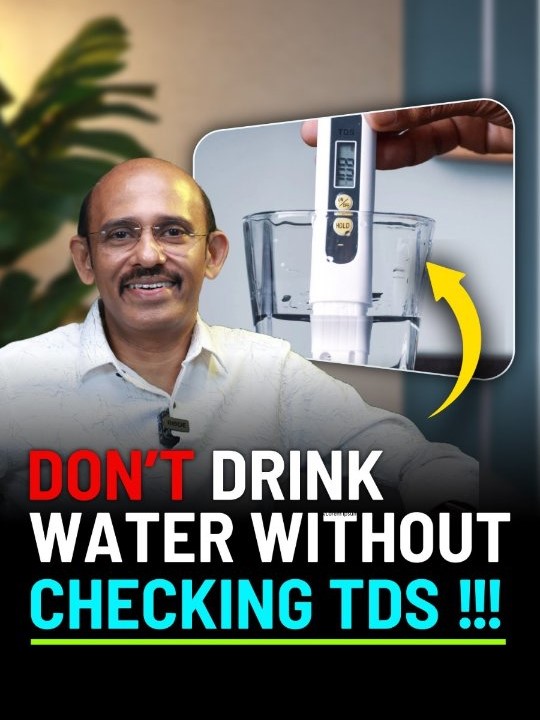
Purchase a reliable, pen-style digital TDS meter online.
Collect a fresh water sample from your tap in a clean glass.
Turn on the meter, submerge the metal electrodes into the water, and wait a few seconds for the reading to stabilise.
2. When to Get a Professional Laboratory Analysis
The 500 ppm Trigger: If your handheld meter shows a TDS reading above 500 ppm, a basic filter won’t be enough. You need to send a sample to a certified laboratory to check for specific contaminants like sulfates, chlorides, and heavy metals.
The Multi-Stage Solution: Choosing the Right Filter
Once you have your laboratory results, you can select a water filtration setup tailored to your specific water profile. A reliable system typically uses a multi-stage process to clean the water thoroughly.
[Raw Borewell Inflow] ➔ [Polypropylene Sediment Stage] ➔ [Activated Carbon Block] ➔ [RO Membrane Filtration] ➔ [Safe Drinking Water Output]
1. Prefiltration (Sediment and Carbon Stages)
Before water reaches the main filtration membrane, it passes through a sediment filter to catch sand, rust, and silt. Next, an activated carbon block absorbs chlorine, organic volatile pollutants, and any unpleasant odors.
2. Reverse Osmosis (RO) Membrane Filtration
The core of the system is the Reverse Osmosis (RO) stage. High pressure forces water through a dense, semi-permeable membrane that blocks dissolved salts, sulfates, and heavy metal ions, allowing only pure water molecules to pass through
[Test Water via TDS Meter] ➔ [If TDS > 500 ppm, Send to Lab] ➔ [Analyze for Metals/Sulfates] ➔ [Install RO Filter]
If you live outside the main municipal water grid or rely heavily on borewell water, you must actively monitor your water quality using a systematic verification process.
Step 1: Get a Handheld TDS Meter
You can easily purchase an affordable digital TDS meter online. This device measures the water’s electrical conductivity to calculate its total dissolved mineral concentration. According to global health guidelines from the World Health Organisation (WHO), water with a TDS level exceeding 2,000 ppm is highly hazardous and should never be consumed
Step 2: Know When to Send Samples to a Lab
The 500 ppm Threshold: If your handheld meter shows a TDS reading above 500 ppm, you should immediately send a water sample to a certified laboratory for a professional analysisA laboratory assessment will break down your water profile to pinpoint specific concentrations of dangerous compounds, including.
Sulfates and Chlorides
Heavy Metals (Lead, Chromium, Cadmium)
Fluoride and Nitrate levels
Step 3: Deploy Targeted Filtration Technology
Once you receive your laboratory report, look for a filtration system designed to handle your water’s specific contamination profile. For water with elevated heavy-metal levels and high TDS, a standard mesh filter is insufficient. You need a robust Reverse Osmosis (RO) filtration system to effectively strip out dissolved solids and chemical compounds at the molecular level.