
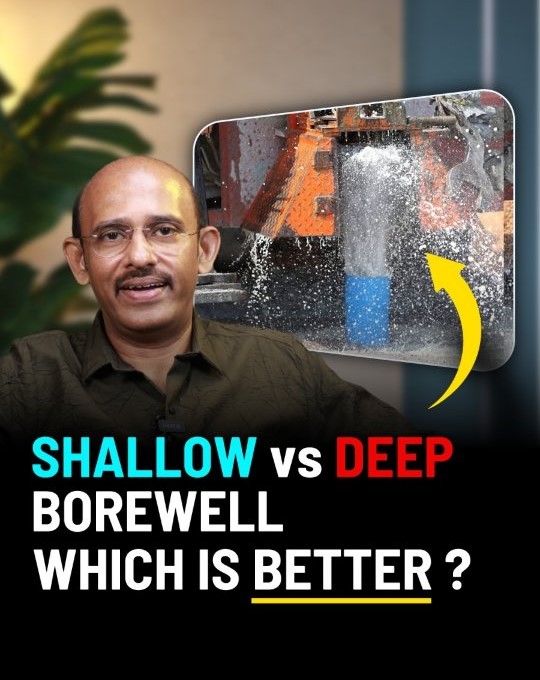
The Foundation of Water Security: Planning Your Home's Shallow vs deep Borewell Depth and Quality
When constructing a new house, drilling a borewell is almost always the very first step on the job site. Water is the lifeblood of both the construction phase and the daily life of the family that will eventually move in. However, despite its critical importance, very few homeowners understand the mechanics of drilling. Most simply leave the decisions entirely to local contractors, leading to long-term issues with water quality, system failures, and expensive plumbing repairs.
How deep should your borewell actually be? How does depth affect the chemical composition of your water? To secure a clean, sustainable, and trouble-free water supply for your home, you must understand the geological, chemical, and environmental factors that dictate water quality beneath your property.
Shallow vs. Deep Borewells: Understanding the Geological Divide
Borewells are broadly divided into two categories based on the depth of the aquifer they tap. Choosing between these two depends heavily on your geographic location, local water table levels, and the intended use of the water.
Ground Level ➔ Shallow Aquifer (20–40 ft) ➔ Deep Aquifer (40 ft to 1000+ ft)
Common Borewell Water Problems and Their Chemical Culprits
While deep borewells are excellent for water quantity, they are notoriously problematic for water quality. If your water chemistry is unbalanced, it will slowly destroy your home’s infrastructure and impact your family’s health.
Hardness: Calcium and Magnesium Build-Up
As deep groundwater moves through underground limestone and chalk deposits, it dissolves significant amounts of Calcium ($Ca^{2+}$) and Magnesium ($Mg^{2+}$). This dissolved mineral load is what makes water “hard”. High hardness levels trigger noticeable daily issues:
Hair and Skin Damage: Hard water prevents soaps from lathering properly. It leaves a sticky residue that clogs pores, dries out the skin, and causes severe hair fall.
Scale Formation: When heated, these minerals solidify into a hard crust known as scale. This white scaling coats bathroom fixtures, ruins glass partitions, and chokes the inside of pipes.
Corrosive Agents: Sulphates and Chlorides
Deep aquifers also frequently carry high concentrations of Sulphates ($SO_4^{2-}$) and Chlorides ($Cl^-$). High chloride levels give water a salty taste and accelerate the corrosion of metal pipes and plumbing joints. High sulphate levels can cause gastrointestinal distress if ingested, and, like hardness minerals, both elements contribute significantly to hair damage and scalp irritation.
Shallow Borewells: Harnessing the Upper Aquifer
A shallow borewell typically reaches a depth of only 20 to 40 feet. These systems tap into upper, unconfined aquifers that are directly replenished by localized surface water runoff and rain.
The Pros: Water from shallow wells is generally sweet, naturally filtered by topsoil layers, and has a very comfortable sensory profile for daily utility use. It mimics natural rainwater, carrying a low mineral load.
The Cons: Because they are shallow, these aquifers are highly susceptible to seasonal fluctuations. They can easily dry up during hot summer months or become contaminated by surface runoff, agricultural pesticides, or nearby sewage leaks.
Deep Borewells: Tapping the Earth’s Deep Reservoirs
Any drilling that goes beyond the 40-foot mark—often reaching depths of 300, 500, or even over 1,000 feet—is classified as a deep borewell. These systems penetrate deep fractured rock layers to access confined aquifers.
The Pros: Deep wells offer exceptional water security. They provide a highly reliable, high-volume water supply that remains consistent even during severe droughts when surface water completely disappears.
The Cons: The deeper you drill, the longer the water has sat in contact with subterranean rock formations. Consequently, deep borewell water absorbs high concentrations of dissolved minerals, leading to major quality challenges.
The Coastal Exception: The Danger of Saltwater Intrusion
If your property is located in a coastal zone—specifically within 100 meters of the sea—the rules of drilling change completely. In these delicate environments, you must restrict your drilling strictly to a shallow borewell of up to 30 feet.
If you drill deep in coastal areas, you risk disrupting the delicate boundary between fresh groundwater and dense seawater. During the hot summer months, when freshwater levels drop, deep wells trigger a phenomenon called saltwater intrusion. This pulls highly corrosive, undrinkable seawater directly into your home’s water supply, permanently ruining your well.
Engineering the Solution: Modern Water Treatment Technologies
Never make the mistake of assuming that a bad water source is a dead end. If your borewell water contains high levels of minerals or chemicals, modern filtration engineering can restore it to pristine standards.
| Water Quality Issue | Primary Indicator | Targeted Filtration Solution |
| High Calcium & Magnesium | White scaling on taps, dry skin, hair fall | Water Softener (Ion-Exchange) |
| High Dissolved Iron | Reddish-brown water, metallic smell, yellow stains | Iron Removal Plant (Oxidation Media) |
| High Chlorides & Sulphates | Salty taste, corroded plumbing | Whole-House RO Plant (Membrane Filtration) |
The Water Softener Solution
For typical hard water issues caused by calcium and magnesium, a dedicated whole-house water softener is the gold standard. These systems use ion-exchange resin beads charged with sodium ions. As hard water flows through the tank, the resin captures the calcium and magnesium ions, releasing harmless sodium ions in their place, resulting in soft, lather-friendly water.
The Iron Removal Solution
If your borewell water looks clear at first but turns a cloudy reddish-brown after sitting in a bucket, you have dissolved iron. This dissolved iron oxidises when exposed to air, leaving unsightly rust stains on clothes, tiles, and fixtures.
To fix this, you must run your water through a specialised Iron Removal Plant. This system uses catalytic media to rapidly oxidise the dissolved iron into solid particles, which are then physically filtered out before the water reaches your overhead storage tank.
The Crucial Step: Never Skip a Professional Lab Water Test
One of the most expensive mistakes homeowners make is trying to treat their water blindly. If your well yields brown or foul-smelling water, do not simply drill another well a few feet away—underground aquifers are connected, and you will likely end up with the exact same water quality.
Instead, collect a fresh sample of your borewell water in a clean bottle and send it to an accredited water testing laboratory. The lab report will provide a precise chemical breakdown of your water’s pH, TDS, hardness, iron, sulphates, and bacterial count. Armed with this exact data, water treatment engineers can design a custom-tailored filtration system that targets your specific contaminants, saving you lakhs in trial-and-error costs.
Demystifying Groundwater Management
Comprehensive Borewell Management Checklist: Secure Your Water Future
To ensure a lifetime of clean, safe water, you must match your borewell depth to your local environment. Keep coastal drilling shallow (under 30 feet) to prevent permanent saltwater damage, and always run a professional lab analysis of deep-well water instead of blindly drilling a second hole if quality issues arise. If your lab report indicates high mineral hardness, install an ion-exchange water softener to protect your hair and home fixtures; if it shows high iron or elevated sulphates and chlorides, install an iron-removal plant or a whole-house RO system to ensure a pure, scale-free water supply at every tap in your home.