
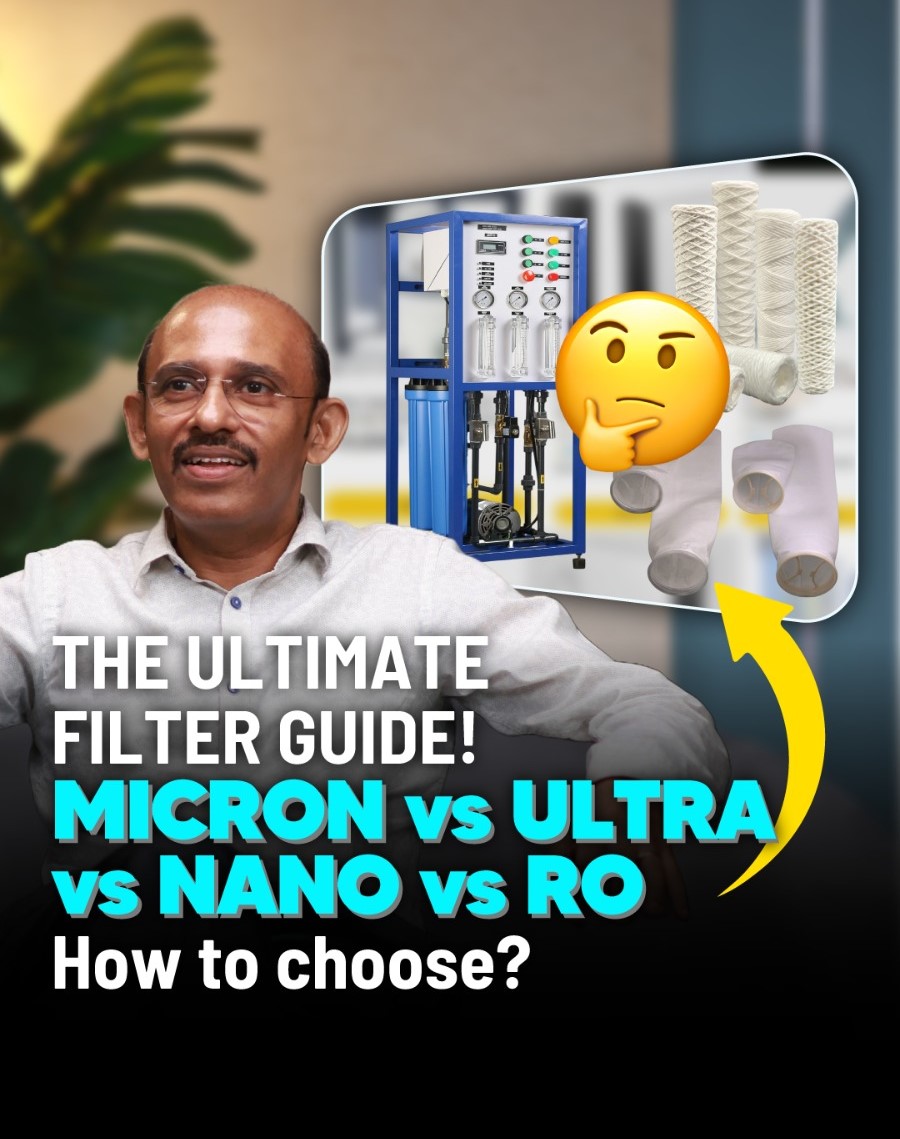
The Ultimate Guide to Home Water Filtration: MICRON vs ULTRA Filteration Choosing the Right System for Your Household
Water is the foundation of life, but the water flowing from your tap may carry hidden impurities that compromise your family’s health, your skin, and your home’s plumbing infrastructure. While many homeowners recognise the need for a water treatment system, a common trap is making a hurried choice without understanding the specific mechanical differences between available filtration systems.
Investing in a water treatment system without analysing your underlying water quality parameters can lead to ineffective filtration, foul odours, or failures of system components. To ensure clean, safe, and reliable water, you must understand the technical distinctions between Micron Filtration, Ultrafiltration (UF), and Reverse Osmosis (RO) architectures.
The Pitfalls of Blindly Purchasing Water Treatment Systems
Many homeowners fall into the trap of installing an expensive water softener or premium purification unit based solely on a neighbour’s setup or a generic sales pitch. Making a blind decision without first running a certified laboratory analysis of your incoming water source can lead to unexpected secondary issues.
For example, a family might spend substantial capital on a whole-house water softener, only to deal with discoloured, foul-smelling tap water shortly after installation. If a water softener is deployed in an environment plagued by unresolved bacterial contamination, iron scaling, or heavy sediment, the core softening media can quickly foul. This leads to system failures and unresponsive customer service disputes
To protect your home and wallet, you must understand the different types of water filtration technologies available.
Raw Water Intake ➔ Water Quality Lab Test ➔ Customized Filtration Pairing ➔ Sustained Pure Water Output
Micron Filtration: The First Line of Defense Against Sediments
The Mechanism of Sediment Removal
Micron filtration serves as the initial physical barrier in a home water purification setup. Its primary function is to trap and remove suspended particulate matter, such as dust, rust flakes, clay, silt, and macro-sediments that are visible to the naked eye.
Navigating Pore Sizes: 10 Micron vs. 5 Micron
Micron filters are classified by their pore ratings, which dictate the smallest particle sizes they can physically capture:
10-Micron Filtration: This configuration features larger pores designed for high-flow locations. It captures large dirt and debris particles, protecting downstream plumbing fixtures from heavy buildup.
5-Micron Filtration: Featuring tighter physical pathways, a 5-micron filter traps smaller, finer sediment particles. This finer filtration step is crucial for shielding delicate downstream components from abrasive wear.
Understanding Filter Cartridge Types: Wound vs. Spun vs. Bag
Not all sediment filters are built the same way. The style of cartridge construction determines its dirt-holding capacity and suitability for your water supply:
1. Wound Type Cartridges
Wound filters are created by wrapping string or yarn tightly around a central core matrix. This design creates a graded density profile that traps larger particles near the outer surface and smaller particles closer to the core. They are ideal for high-sediment applications.
2. Spun Type Cartridges
Spun filters are manufactured using a melt-blown polymer technique that produces a dense, multi-layered fibre matrix. Spun filters are frequently rated down to 1 micron, providing fine, consistent polishing filtration that effectively captures tiny organic and mineral particles.
3. Bag Filters
Bag filters consist of a replaceable fabric bag housed inside a specialised pressure vessel. Typically rated at 10 microns or higher, bag filters excel at handling high flow rates and heavy sediment loads, making them an excellent pre-treatment choice for raw borewell water or municipal surface water.
Ultrafiltration (UF): The Molecular Shield Against Biological Pathogens
While micron filters are great at stopping sand, dirt, and rust, they are completely ineffective against microscopic biological hazards. This is where Ultrafiltration (UF) comes in.
Ultrafiltration utilises an advanced hollow-fibre membrane structure with an incredibly fine filtration rating of up to 0.01 microns. At this molecular level, the physical barrier blocks almost all microbiological contaminants.
The pore paths are tight enough to strain out harmful bacteria (such as E. coli and Salmonella) and many types of viruses, keeping them out of your home’s drinking supply.
The Correct Engineering Flow: Pairing Micron Filters with UF Systems
A common system design error is trying to route raw, unfiltered water directly into a delicate ultrafiltration membrane. Because a UF membrane has tight 0.01-micron pores, heavy incoming sediment will quickly clog its surface, leading to rapid pressure drops and membrane damage.
To ensure reliable, long-term performance, systems must be installed in the correct engineering sequence:
Raw Water ➔ Micron Pre-Filter (Removes Dust/Rust) ➔ Pressure Booster Pump ➔ Ultrafiltration Membrane (Blocks Pathogens) ➔ Safe Water
By routing incoming water through a preliminary micron or bag filter, you catch the heavy sediment early. The pre-filtered water is then pushed through a pressure booster pump and into the ultrafiltration core. This step filters out bacteria and viruses without overloading the system, keeping your water supply completely clean.
Reverse Osmosis (RO) vs. Ultrafiltration: Understanding Mineral Levels
When choosing a high-purity water system, you must understand how Ultrafiltration (UF) differs from Reverse Osmosis (RO) regarding Total Dissolved Solids (TDS):
| Technical Criteria | Ultrafiltration (UF) System | Reverse Osmosis (RO) System | |
| Pore Filtration Rating | Approximately 0.01 microns | Approximately 0.0001 microns | |
| Pathogen Protection | Rejects bacteria and viruses | Eliminates all pathogens, heavy metals, and salts | |
| TDS Reduction | Does not reduce dissolved salts/minerals | Significantly reduces overall TDS levels | |
| Waste Water Stream | Minimises water waste during operation | Requires a continuous wastewater reject stream | |
| Ideal Water Condition | Best for water with low TDS but high biological risks | Best for hard, high-TDS, or chemically contaminated water |
Because Reverse Osmosis uses a tight 0.0001-micron pore structure, it removes nearly all dissolved minerals. For raw water supplies with a moderate, balanced mineral profile, an ultrafiltration setup is often preferred. It provides complete protection against microbes while preserving the natural, healthy levels of calcium and magnesium in your water.