
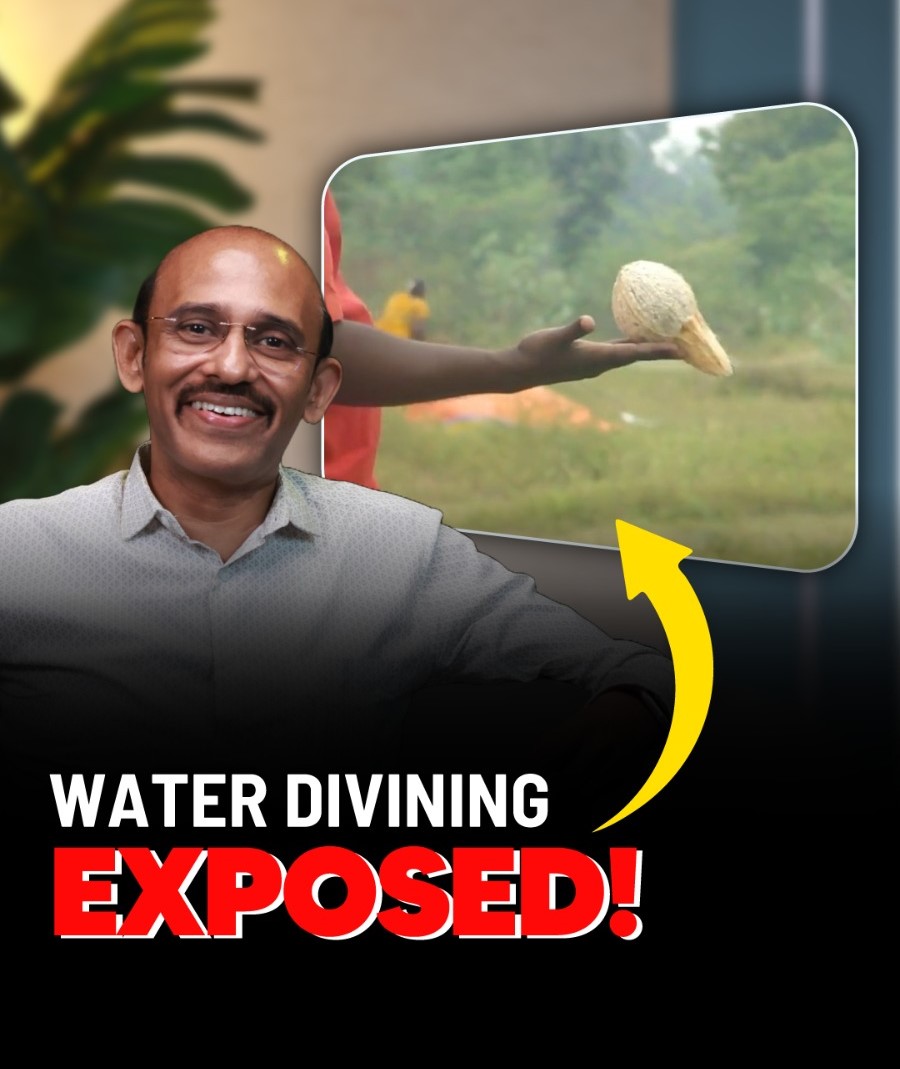
The Myth of Water Divining: Separation of Science and Folklore
For generations, communities looking to dig a well or sink a borewell have relied on traditional dowsers or water diviners. These traditional methods often involve someone walking across a plot of land, holding a dry coconut in their open palm or a flexible Y-shaped stick.
[Traditional Dowsing: Coconut / Y-Stick] ➔ Triggers Human Ideomotor Movements ➔ Outdated Folklore
[Scientific Technology: Hydrogeological Testing] ➔ Measures Electrical Resistivity ➔ Valid Groundwater Mapping
Folklore says that when the diviner walks over a hidden underground stream, the coconut will mysteriously stand upright or the stick will pivot upward on its own. Some regional stories even claim that if a cow repeatedly rests in a specific spot, it indicates a high water table just below.
The Scientific Truth: There is absolutely no verifiable scientific evidence supporting these traditional methods.
When a dowsing tool moves, it isn’t caused by underground water currents pulling on the object. Instead, it is caused by involuntary muscle movements in the holder’s hands, known as the ideomotor phenomenon. Relying on folklore instead of scientific equipment is risky and can lead to costly drilling mistakes.
The Barnum Effect in Water Dowsing
To understand why so many people still believe in traditional water divining, we can look at a well-known psychological concept called the Barnum Effect.
Understanding the Psychology
The Barnum Effect is a psychological phenomenon where individuals believe that generic, universally applicable statements are highly specific and tailored just for them. It is the same method used by stage astrologers and palm readers. They read your body language, listen to the concerns of the people with you, and give broad, reassuring answers that feel uniquely accurate.
Application to Water Finding
Traditional water locators use these same behavioural cues. They evaluate the natural vegetation on the land, look for lower-elevation areas where rainwater naturally collects, and check existing nearby wells.
When they combine these natural clues with confident, reassuring statements, it can look like an ancient art. In reality, the only reliable way to map underground water systems is through proper scientific technology, such as geological surveys and electrical resistivity testing.
Borewell Realities: Shallow vs. Deep Water Safety
When planning a home borewell, drilling deeper doesn’t always mean getting better, safer water.
│ Shallow Borewells (10 – 20 feet deep) │
│ Can work well in cooler areas with healthy local water tables. │
VS
│ Deep Borewells (Hundreds of feet down) │
│Higher risk of pulling up heavy metals and ancient mineral compounds.│
The Case for Shallow Wells: In areas with a healthy, cool water table, a shallow well reaching just 10 to 20 feet down can often provide clean, reliable water.
The Danger of Deep Wells: Deep borewells present a much higher risk of contamination. Sinking a pipe hundreds of feet into the earth taps into older, stagnant deep aquifers. This deep water has spent decades or centuries dissolving surrounding rock formations, meaning it often carries heavy concentrations of dissolved minerals, salts, fluorides, and heavy metals.
The Hidden Hazards of Environmental Contamination
Many people move to rural outskirts or farming areas, assuming that leaving the city means escaping pollution. However, modern environmental pollution affects every stage of the natural water cycle.
[Industrial Air Pollution & Smog] ➔ Mixes with Rainwater ➔ [Contaminated Groundwater Supply]
[Agricultural Pesticides / Fertiliser Runoff] ➔ Leaches into Deep Aquifers ➔ [Toxic Borewell Intake]
From Sky to Ground
Pure water typically begins as rain, but industrial air emissions and city smog pollute rainwater long before it ever touches the ground. As this polluted rain falls, it mixes with existing contaminants in surface soils and slowly seeps deep into local underground aquifers.
Agricultural Runoff Risks
In rural and agricultural areas, intensive farming activities introduce significant amounts of chemical pollutants into the soil. Modern chemical fertilisers are packed with concentrated nitrogen and phosphorus compounds. Over time, rainwater washes these chemicals and harsh commercial pesticides deep into the earth.
Even commercial aquaculture facilities release nutrient-heavy, chemically treated wastewater that can filter down into surrounding groundwater networks.
The Multi-Lakh Mistake: Why You Must Test Your Water First
A common home improvement mistake is buying a water treatment system before testing your actual water quality.
A Real-World Example: A homeowner recently spent nearly 1.5 Lakhs on installing a premium whole-house water softening system alongside a dedicated kitchen drinking water filter.
Despite this major financial investment, their water quickly turned a strange, discolored hue and began emitting a foul odor reminiscent of rotten eggs. The installation company offered no solution because the equipment itself wasn’t broken; it was simply the wrong machine for the job.
[Un-Tested Water Setup] ➔ 1.5 Lakhs Spent ➔ Wrong Solution ➔ Persistent Odor & Odious Color
[Lab Test First Approach] ➔ Identifies Real Problem (e.g., Iron) ➔ Target Action ➔ Pure Water Success
A subsequent laboratory evaluation revealed that the home did not have a hard water problem at all. Instead, the well had a severe iron contamination issue. Because the system was designed to remove calcium and magnesium rather than filter out iron, the expensive water softener was completely ineffective.
Always send a water sample to a certified laboratory to identify your specific water issues before purchasing any filtration or softening equipment.
Demystifying the RO Dilemma: Mineral Depletion vs. Enrichment
A common online debate is whether Reverse Osmosis (RO) purification systems are harmful to your long-term health.
The Low-TDS Mineral Concern
It is a scientific fact that standard RO membranes remove a large portion of the dissolved minerals from source water. Years ago, popular bottled water brands frequently sold purified water with Total Dissolved Solids (TDS) levels dropping well below 10 ppm.
Drinking water with an extremely low mineral count can cause it to act like a sponge, pulling small amounts of essential minerals like calcium and magnesium from your body’s tissues.
A subsequent laboratory evaluation revealed that the home did not have a hard water problem at all. Instead, the well had severe iron contamination. Because the system was designed to remove calcium and magnesium rather than filter out iron, the expensive water softener was completely ineffective.
Always send a water sample to a certified laboratory to identify your specific water issues before purchasing any filtration or softening equipment.
| Water Type Metric | Ultra-Low TDS Water (<10 ppm) | FSSAI Approved Mineralised Water | |
| Calcium Component | Near zero milligrams per litre | 20 to 75 mg per litre | |
| Magnesium Component | Near zero milligrams per litre | 5 to 30 mg per litre | |
| Physiological Impact | Can pull essential minerals from body tissues | Helps maintain daily mineral balance safely |
The Modern Standard Balance
To protect consumer health, food safety organisations like the FSSAI have updated their standards for packaged drinking water. Today, manufacturers use mineral-addition cartridges to reintroduce essential elements back into the water after the intensive filtration process.
These systems are carefully calibrated to ensure that final drinking water supplies contain 20–75 mg/L of calcium and 5–30 mg/L of magnesium. While a balanced daily diet supplies the majority of your body’s nutrients, drinking properly mineralized RO water ensures you stay well-hydrated without losing important minerals.
The Long-Term Asset: Combating Global Water Waste
When passing down assets to future generations, most families focus on real estate, property investments, or financial savings. However, as environmental pressures increase worldwide, access to clean, unpolluted drinking water is quickly becoming one of the world’s most valuable resources.
[Unmonitored Flat Complexes] ➔ Millions of Litters Wasted Monthly ➔ Depleted Clean Water Reserves
[Home Digital Water Meters] ➔ Real-Time Usage Transparencies ➔ Sustained Resource Conservation
Despite this growing scarcity, residential water waste remains a significant issue worldwide, with old infrastructure and unmonitored plumbing causing immense losses every day. In large apartment complexes and multi-family high-rises housing hundreds of separate families, master storage tanks frequently overflow, wasting thousands of gallons of clean water.
To address this issue, modern properties are installing dedicated digital water meters for each home unit. Tracking real-time consumption helps people understand their daily water footprint, find hidden leaks early, and actively conserve water. Protecting our shared groundwater reserves today ensures that future generations will have access to clean, reliable water.